
The New Era of Kabaddi: From Clay Courts to a Matted Marketplace
कबड्डी एक संपर्क-आधारित टीम खेल है जिसमें सात खिलाड़ियों की दो टीमें मैट पर खेलती हैं। एक रेडर विपक्षी आधे हिस्से में जाकर टच या बोनस अंक कमाता है, जबकि डिफेंडर उसे रोककर टैकल अंक बनाते हैं। सफल टच और टैकल पर एक-एक अंक, बोनस पर अतिरिक्त अंक, तथा सुपर टैकल पर दो अंक मिलते हैं; सभी खिलाड़ियों के आउट होने पर 'ऑल आउट' के दो अंक मिलते हैं। 2014 में शुरू हुई प्रो कबड्डी लीग ने खेल को पेशेवर फ्रेंचाइज़ी मॉडल, टेलीविज़न कवरेज और वाणिज्यिक प्रायोजन से जोड़ा। भारत अंतरराष्ट्रीय स्तर पर सबसे सफल टीम है, जबकि ईरान प्रमुख प्रतिद्वंद्वी के रूप में उभरा है। कबड्डी एशियाई खेलों का स्थायी खेल है।
In a village field somewhere in India, a white line drawn in the dirt, twenty-odd children, and a single word chanted on one breath — 'kabaddi-kabaddi.' For decades, that image defined the sport. Over the past ten years, the picture has changed rapidly. Air-conditioned arenas, television cameras, franchise teams, players auctioned for crores, and live statistics on the screen — kabaddi is no longer just a traditional game, but an organised, professional, market-driven industry. The shift raises a fundamental question: has the soul of the sport survived, or has it altered its character under the pressure of competition?
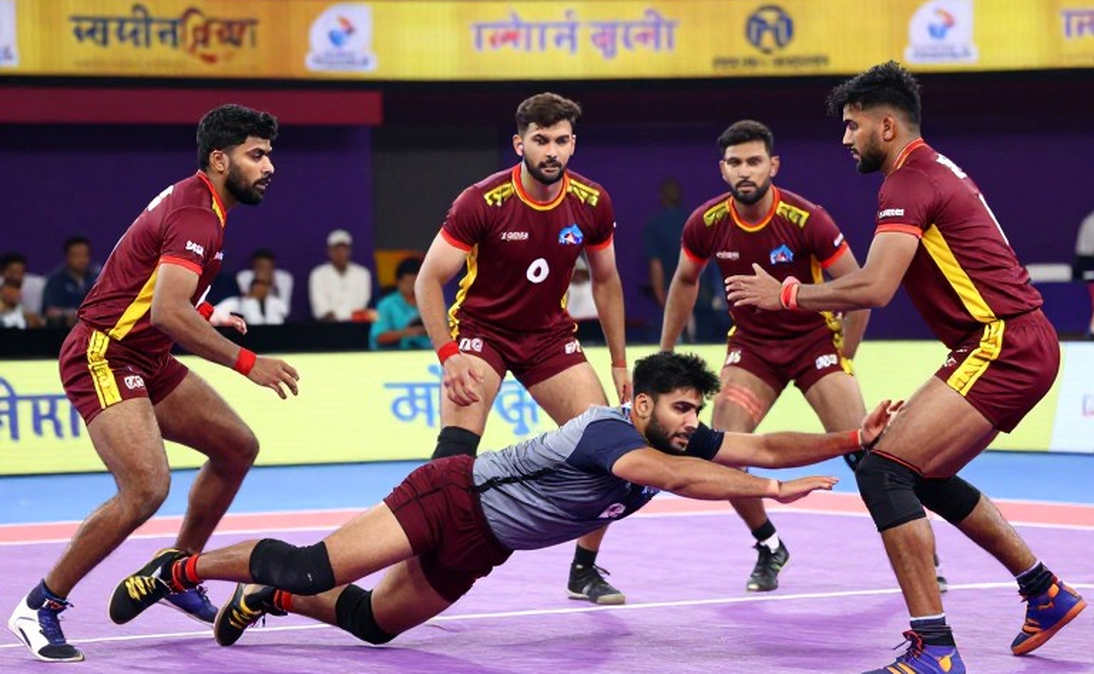
To understand kabaddi, one must first understand its structure. It is a sport where attack and defence switch in the same instant. A player from one team — the raider — crosses into the opponent's half and must tag or catch defenders before returning. A successful raid earns points; a successful tackle earns them for the opposition. This simple rule is the seed of the sport's entire complexity, because every raid is a calculated gamble and every tackle a computation.
The dimensions of the mat shape that tension. At the professional level, it is roughly 13 metres long and 10 metres wide, split by a mid-line. Each half contains a bonus line and a baulk line. Crossing beyond the bonus line allows a raider to claim an extra point, but it lengthens the return path. This small geographic detail governs the entire tactical framework — how deep a raider should venture is his hardest decision.
Each team fields seven players, and only seven are eligible to raid. When all players of a team are out, an 'all out' is awarded, giving the opposition two extra points and returning all players to the mat. This rule transforms the arithmetic of a match. A team leading by three or four points can fall behind after a single all out. Coaches and captains therefore constantly balance aggression against safety.
The scoring system explains why the sport keeps getting faster: one point per successful touch, an extra point for a bonus, one point per successful tackle, and two for a 'super tackle' — executed when three or fewer defenders stop a raider. There is also the 'super raid,' where a single raid yields three or more points. These rules make the game thrilling and tie strategy directly to statistics.
The evolution of raiding is the most compelling story in the sport. Early raiders simply went in, touched someone, and hurried back. As defences hardened, raiding became an art. Modern raiders fall into three categories: speed-based raiders who confuse defenders with agility; power-based raiders who rely on physical strength and the ability to break holds; and intelligence-based raiders who read defender positions and find open space.
The bonus point has grown enormously in importance. When a raider nears the baulk line, defenders step forward to stop him, briefly opening space behind the bonus line. Skilled raiders sense that opening. But the strategy carries risk — a raider caught chasing a bonus gifts the opposition an easy point. The bonus decision is always a calculation, never an impulse.
The 'do-or-die raid' is the sport's most dramatic moment. After three consecutive empty raids, the fourth raider has no option but to score — returning empty-handed means elimination. This rule pushes tension to its peak in the closing minutes. Spectators know something is about to happen; players know a single error can turn the match.
Defence, by contrast, is often undervalued, yet the data is clear: championship teams are almost always built on strong defences. A good defence operates in four ways — the ankle hold, controlling the raider's foot; the thigh hold, breaking balance with a grip on the thigh; the block, using the body to close the path; and the dash, sprinting from distance to stop a raider inside the boundary.
Defensive strength lies not in individual skill but in coordination. A cover defender's job is to anticipate a partner's mistake and cover it instantly. When two defenders tackle together, the probability of success multiplies — but if the coordination breaks, both are wasted and the raider walks away with an easy point. This is why modern kabaddi treats communication as a technical skill.
In recent years, data analysis has entered the sport. Teams record an opposing raider's habits — which direction he favours, how much risk he takes chasing bonuses, how he reacts under pressure. Defenders' tackle patterns are analysed the same way. Cricket and football travelled this road first; kabaddi is now following.
All of this modernisation traces back to one event: the arrival of the Pro Kabaddi League. Launched in 2026, the league transformed the sport's economy, its presentation, and its audience base. Watching kabaddi on television was once rare; today it is among the country's most-watched league sports. The franchise model connected cities to teams, and local pride drew crowds into stadiums.
The league's greatest contribution has been to players' economic standing. Previously, kabaddi players largely depended on government jobs in railways or police departments through sports quotas. The league gave them a platform where performance had direct monetary value. Auctions, contracts, brand endorsements — none of these were part of the sport's vocabulary before.
There is another side to this change: players are now not only athletes but public figures. Their social media, their statements, their lifestyles are all observed. Popularity has grown, but so has pressure. A young player who once competed only for his village is now scrutinised nationally for every error.
Among the stars, a few names have become synonymous with the sport. Pawan Sehrawat is known for explosive pace and fearless raiding; he can turn a match in a single raid. Naveen Kumar is recognised for consistency and composure — he rarely returns empty. Pardeep Narwal is regarded as the most successful raider of the modern era; his 'dubki' and unpredictable changes of direction challenged conventional defensive understanding.
On defence, foreign players such as Fazel Atrachali proved the sport is no longer confined to India. Athletes from Iran earned places in the league through physical strength and technical discipline, presenting Indian defenders with a new challenge. This international mix raises the standard, because every player must prove himself against unfamiliar styles.
Women's kabaddi is the fastest-growing stream. National-level women's tournaments existed earlier, but organised leagues and television coverage have arrived in recent years. Fitness, technique, and tactical understanding among women players are now being developed seriously. The Indian women's team's performances at the Asian Games show that high-level talent exists when investment and opportunity are provided.
Internationally, India's dominance is clear, but one-sidedness is declining. Iran has emerged as the strongest rival over the past decade and has pushed India hard in major tournaments. South Korea, Thailand, Bangladesh, and Japan have organised their programmes. Kabaddi's permanent place at the Asian Games provides a foundation for global expansion, though entry into the Olympics remains a distant prospect.
Commercially, kabaddi's model is interesting. The sport depends mainly on the domestic market — audiences, broadcast rights, and sponsorship are all India-centric. That is both a strength and a limitation: a strength because India offers an enormous audience base, a limitation because international revenue opportunities remain scarce. The league's long-term stability will depend on whether it merely expands its audience or deepens it.
At the grassroots, the picture is mixed. Kabaddi's presence in school and college sport has traditionally been strong, especially in Haryana, Uttar Pradesh, Maharashtra, Tamil Nadu, and Karnataka. But organised talent scouting and scientific training remain concentrated in urban centres. Talent is abundant in villages; the scaffolding to refine it is uneven.
Injuries are a serious issue. Kabaddi involves direct physical contact, and knee, ankle, and shoulder injuries are common. Playing on mats has reduced some risk, but greater tackle speed and intensity have created new stresses. Recovery protocols, medical staff, and workload management are now essentials, not luxuries.
Workload and calendar are also debated. League schedules are dense, and back-to-back matches take a toll. Many experts believe balancing national camps, international competitions, and the league is a major challenge. If players break down from fatigue, the sport ultimately pays.
Through all of this, one thing is clear: kabaddi has changed its identity but has not lost it. The sport played on mats still rests on the same core skills it did in the village arena — holding your breath as you advance, deciding in an instant, and facing an entire team alone. The technique has changed, the stage has changed, the money has changed; the courage has not.
The road ahead lies in three directions. First, give women's kabaddi structural support equal to the men's game — organising tournaments is not enough; training, medical care, and financial security are needed. Second, pursue internationalisation seriously, so the sport does not remain a domestic product of one country. Third, prioritise player welfare, because no sport is bigger than its players.
Finally, a note that is often missed. Kabaddi's greatest strength is its simplicity. It requires no expensive equipment and no special ground — an open space and a few friends suffice. That is why the sport reached every corner of India. If professionalism erodes that simplicity, the sport will lose its greatest advantage. The real challenge is to stay modern while remaining the people's game.
संबंधित खिलाड़ी
अनुशंसित
First Commonwealth Kabaddi Championship in Ahmedabad: 62 Matches, 13 Nations and the CWG 2030 Test2026-10-29
Commonwealth Kabaddi: Surjeet Captain, Naveen Vice-Captain — A 'Next-Gen' Call or Retention Politics?2026-10-22
Kabaddi's 'Commonwealth' Gamble in Ahmedabad: 62 Matches, 13 Nations, and One Big Question2026-10-22
Kabaddi's Commonwealth Gamble in Ahmedabad: 62 Matches, 13 Nations and One Missing Name2026-10-22
Commonwealth Kabaddi Championship: Pakistan's Late Withdrawal Cuts the Field from 14 to 13, and the Question the Draw Sheet Never Recorded2026-10-22
The New Era of Kabaddi: From Clay Courts to a Matted Marketplace2026-11-01
Surjeet Singh Captain, Naveen Kumar Vice-Captain: The Three Questions the Commonwealth Championship Announcement Left Out2026-10-22
अनुशंसित
The Ledger of the Transfer Window: Who Gets Priced, and Why, in Kabaddi2026-10-31
Every Big Kabaddi Headline Is Full of Claims and Empty of Receipts — And That Is the Sport's Costliest Deficit2026-10-31
Pakistan's Withdrawal Leaves Commonwealth Kabaddi With an Emptiness, Not a Contest2026-10-22
Surjeet Singh Captain, Naveen Kumar Vice-Captain — and the One Fact the Press Release Left Out2026-10-22
Surjeet Singh Captain, Naveen Kumar Vice-Captain: The Commonwealth Kabaddi Championship 2026 Announcement and the One Line That Doesn't Match the Note2026-10-22
Commonwealth Kabaddi Championship 2026: Surjeet Singh Captain, Naveen Kumar Vice-Captain — A Release With Titles But No Team2026-10-22
Commonwealth Kabaddi's Ahmedabad Debut: 62 Matches, 13 Nations, and One Absent Iran2026-10-22